Organizational Readiness • Capacity Building • Durable Change

Implementation
Capacity
Framework™

From Initiative to Impact

A recursive five-domain conceptual framework for building the individual and organizational conditions that help worthwhile initiatives take hold, improve, endure, and scale responsibly.

Implementation succeeds when capacity is built, not assumed.
Developed by Kendra SimmsUnpublished conceptual framework
Explore

The central proposition

Good ideas do not implement themselves.

Organizations often select a worthwhile practice, communicate expectations, deliver training, and assume reliable implementation will follow. The Implementation Capacity Framework™ rejects that assumption. It asks leaders to deliberately build the conditions between intention and consistent practice.

The diagnostic question is simple: What has to become true for this change to work here?

What the framework builds

Understanding • Trust • Skill • Confidence • Tools • Supported practice • Feedback • Organizational learning • Internal ownership

What the framework detects

Initiative fatigue • Silent compliance • Inadequate practice • Punitive monitoring • Data without decisions • Premature scale

Framework at a glance

Five domains. Five conditions. One recursive system.

The domains provide orientation, not a rigid checklist. Evidence from any point may send an organization back to strengthen an earlier condition.

01Willingness
02Ability
03Consistent Use
04Evidence for Decisions
05It Sticks
01

Readiness and Buy-In

Establish whether people understand the problem, see the change as relevant, trust the purpose, and have the minimum conditions needed to begin.

Explore domain
02

Capacity Building

Develop the knowledge, skill, confidence, time, tools, resources, and practice opportunities required for reliable performance.

Explore domain
03

Supported Implementation

Move the practice into authentic working conditions while leaders coach performance, solve problems, and remove organizational barriers.

Explore domain
04

Embedded Evaluation and Continuous Improvement

Produce decision-ready evidence about implementation, quality, outcomes, equity, experience, workload, and unintended effects.

Explore domain
05

Sustainability and Scale

Build an organizational system that survives turnover, preserves essential components, and expands only when evidence and capacity support it.

Explore domain

Inside the framework

The five domains in practice.

Each domain identifies a condition to build, evidence to examine, and a characteristic failure pattern to prevent.

01
Result: Willingness

Readiness and Buy-In

Establish whether people understand the problem, see the change as relevant, trust the purpose, and have the minimum conditions needed to begin.

Guiding questionAre people willing, aligned, and prepared to engage in the change?
Core work
  • Clarify the actual problem and baseline
  • Listen for barriers, concerns, and access risks
  • Confirm ownership, time, staffing, tools, and resources
  • Define a realistic starting scope
02
Result: Ability

Capacity Building

Develop the knowledge, skill, confidence, time, tools, resources, and practice opportunities required for reliable performance.

Guiding questionCan people demonstrate the practice under realistic conditions?
Core work
  • Provide role-specific learning and clear models
  • Use guided practice, simulation, and teach-backs
  • Build usable job aids, workflows, and decision tools
  • Protect time for learning, feedback, and calibration
03
Result: Consistent Use

Supported Implementation

Move the practice into authentic working conditions while leaders coach performance, solve problems, and remove organizational barriers.

Guiding questionAre people supported while using the practice in the real work?
Core work
  • Begin with a bounded pilot or implementation unit
  • Provide job-embedded coaching and rapid assistance
  • Review and remove barriers close to the work
  • Use gradual release with clear role ownership
04
Result: Evidence for Decisions

Embedded Evaluation and Continuous Improvement

Produce decision-ready evidence about implementation, quality, outcomes, equity, experience, workload, and unintended effects.

Guiding questionWhat does the evidence tell us to continue, revise, pause, or scale?
Core work
  • Define essential and adaptable components
  • Measure implementation alongside outcomes
  • Examine access, experience, burden, and balancing measures
  • Use short learning cycles to select the next revision
05
Result: It Sticks

Sustainability and Scale

Build an organizational system that survives turnover, preserves essential components, and expands only when evidence and capacity support it.

Guiding questionCan the practice endure without one champion and expand responsibly?
Core work
  • Build onboarding, refreshers, and recurring calibration
  • Develop internal coaches, documentation, and succession
  • Place time, staffing, tools, and technology in routine budgets
  • Use formal decisions before expansion

Recursive by design

Movement backward can be evidence of learning.

The framework is not a one-directional launch sequence. When implementation reveals a weak condition, leaders return to the domain most capable of correcting it. The goal is not to move through five boxes. The goal is to build a system that can learn.

AssessLearnModelCoachMeasureRefineSustain
Low participationReturn to readiness, purpose, trust, and workload conditions.
High error in authentic useRebuild capacity or redesign implementation supports.
Positive outcomes, excessive burdenRevise support, workflow, and resource conditions.
Fidelity driftClarify essentials, strengthen onboarding, and recalibrate.
Success in one settingBegin a new readiness cycle before expanding elsewhere.

Measurement architecture

Outcome data alone cannot tell the implementation story.

Evidence becomes implementation intelligence only when it informs a decision, support, practice, or organizational condition.

01

Implementation

Was the practice used, by whom, how often, and under what conditions?

02

Fidelity and quality

Were essential components present, correct, consistent, and delivered well?

03

Outcomes

Did the intended result improve meaningfully and remain stable over time?

04

Equity and access

Who received access, who benefited, and who was underserved or excluded?

05

Stakeholder experience

Did people understand the practice and experience it as useful and feasible?

06

Workload and capacity

Was the work manageable with the available time, staffing, tools, and technology?

07

Balancing measures

Did improvement in one area create a problem somewhere else?

08

Adaptation

What changed, why did it change, and what happened to integrity and results?

Decision discipline

Every evidence review should change something or confirm why it should not.

Formal decision points keep organizations from confusing activity with progress or early enthusiasm with sustainable capacity.

01

Continue

Current conditions support continued use while learning remains active.

02

Revise

Evidence points to a specific change in the design, support, tool, or condition.

03

Pause

The system is not ready to proceed responsibly without additional work.

04

Scale

Evidence and internal capacity support expansion into a new readiness cycle.

Where it applies

Use the framework wherever people must change what they do.

The ICF is intentionally context-flexible. It examines implementation conditions rather than prescribing one industry, intervention, or technology.

01New programs and service models
02Technology and responsible AI adoption
03Policy and compliance changes
04Process and workflow redesign
05Cross-team or cross-site initiatives
06Scaling a promising practice

Public resource

Take the framework with you.

Download the six-page Implementation Capacity Framework™ Executive Overview for a concise introduction to the framework's central proposition, recursive logic, five domains, evidence categories, and decision discipline.

Download the Executive OverviewPDF • 6 pages

May be shared intact for noncommercial informational use with clear attribution to Kendra Simms.

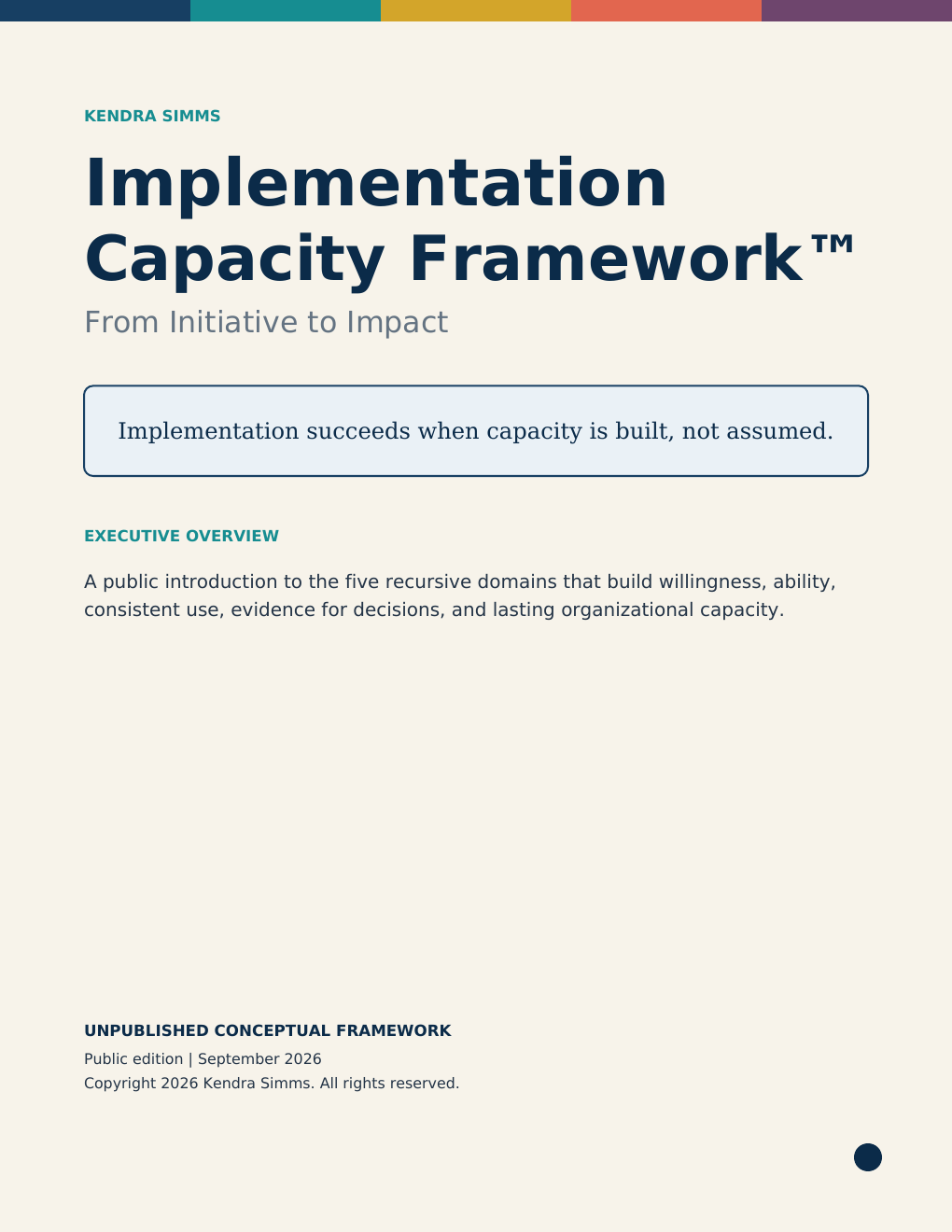
Cover of the Implementation Capacity Framework Executive Overview by Kendra Simms
Public edition • September 2026

About the originator

Improvement work built for the people carrying it.

Kendra Simms is an implementation strategist, school-improvement researcher, and doctoral candidate at The University of Texas at Tyler. Her work focuses on closing the gap between good ideas and successful implementation.

Her professional experience spans process improvement, special education, instructional and team leadership, policy exposure, and systems-level problem solving. Frontline practice gives her a direct view of the workflow, capacity, and adoption conditions that determine whether organizational change reaches the people it is intended to serve. She also participated in the Graduate Archer Fellowship in Washington, D.C., including special education policy exposure on Capitol Hill.

Simms developed the Implementation Capacity Framework™ to help leaders diagnose whether an implementation problem reflects readiness, capacity, support, evaluation, or sustainability conditions before assigning blame or adding another initiative.

School improvementImplementation capacitySystems thinkingContinuous improvement

Evidence status

Developed with precision. Presented with transparency.

The Implementation Capacity Framework™ is conceptually developed and operationally detailed. It is informed by recognizable implementation, improvement, evaluation, coaching, and sustainability principles.

The complete five-domain framework has not yet been formally field-tested or empirically validated and should not be represented as a proven model. Future field use can produce implementation evidence, case studies, refined tools, and formal evaluation findings.

Attribution and use

Original work by Kendra Simms.

Implementation Capacity Framework™ identifies this original conceptual framework and its source. The original written expression, visual architecture, graphics, and compiled materials presented here are protected by copyright. Generic implementation terminology is not claimed as exclusive.

No reproduction, adaptation, training, commercial use, or derivative presentation of the protected materials is permitted without written authorization from Kendra Simms.

Speaking • Consulting • Collaboration • Framework permissions

kendrasmms@gmail.com